


Interview with Anne-Sophie Pic, multi-starred chef
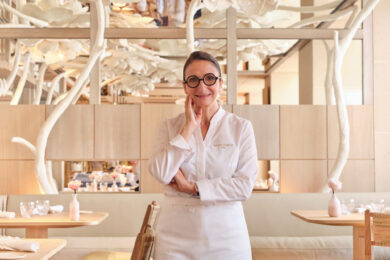
By Katia Kulawick-Assante
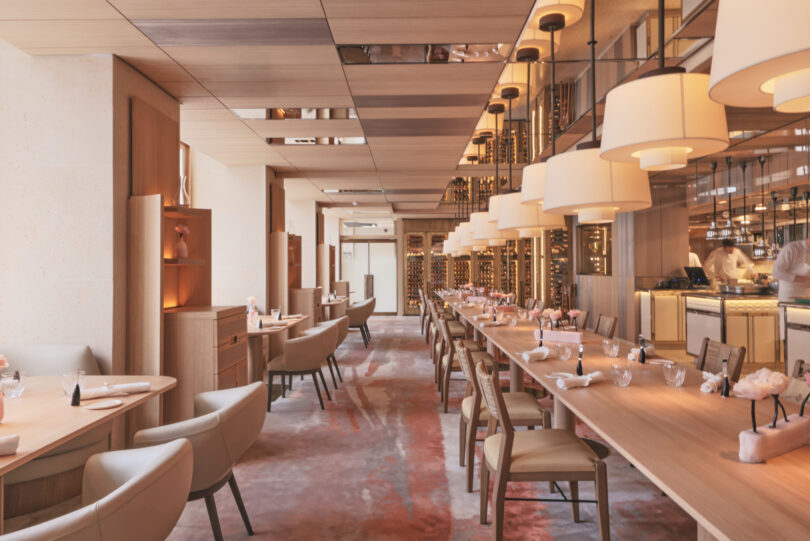
We’re in your new Parisian restaurant, housed within the new Fondation Cartier for Contemporary Art, opposite the Louvre… Tell us how this adventure began?
One evening in August 2023, Alain Dominique Perrin rang us – David (Sinapian, her husband and Chairman of the Pic Group, who has been by her side for 35 years) and myself. He told us that the Cartier Foundation for Contemporary Art was moving: “We have a magnificent space and we’d love for you to come and see it,” he said. We thought it would be a wonderful opportunity to seize, to link this gastronomic venue with the arts. We still can’t believe it’s true!
Did you close Dame de Pic on Rue du Louvre in preparation for this opening?
Yes, because it didn’t make sense to have two venues so close together. We’re sounding out the market to see whether we’ll go for a concept other than a restaurant or whether we’ll sell it; we’ll probably opt to sell because this new venue at the Foundation will take up all our time.
Does this opening in Paris mean you have to think and do things differently from how you do in Valence, your stronghold?
Oh yes. I don’t want to replicate Valence. La Maison Pic in Valence remains what it is (the parent establishment with a three-Michelin-starred gourmet restaurant founded by my family, a bistro, a hotel and a boutique – Ed.). Let’s say that Paris is a second home. Of course, it’s also my cuisine; you’ll find my signature flavour profile there, but I want it to be even more refined, more vibrant, and on the cutting edge too, like contemporary art. I want to offer something different; I don’t want people to come here thinking there’s no point in going to Valence, or vice versa. At the same time, we’re going to start reinventing the dining experience in Valence with the artists Cyril Teste and Nina Chalot, who have worked here. I want to revolutionise what happens in the dining room there because we have plenty of space – a garden, a cellar, and so on. There are several scenarios to explore, a guest journey where people will move from one space to another, like a journey. Here, at the Cartier Foundation for Contemporary Art, it will be more of a stationary journey, featuring interactions and visual elements. We mustn’t let the visitor get bored!
Alain Dominique Perrin, Chairman and founder of the Cartier Foundation for Contemporary Art, chose you to take on and represent this venue, which bridges the worlds of art and gastronomy. Do you know what motivated his choice?
I don’t know. I know that some close associates may well have encouraged this bold decision to appoint a woman… Alain Dominique Perrin is familiar with our restaurant, Valence; he’s visited it and knew my father. This connection is important to him because he’s someone who is extremely loyal in his friendships. We’ve had a lot of contact over the past three years, and he’s visited Dame de Pic several times. So did Jean Nouvel. Things fell into place naturally, based on mutual trust and complete freedom – just as he gives artists the freedom to create. He conceived this corporate foundation in 1984 with the aim of supporting artists, particularly César – I was told this by Bénédicte Jarosz, Director of Strategy and Development at the Cartier Foundation for Contemporary Art.
It was only later that the idea arose to promote lesser-known artists through the foundation. It’s a wonderful story. As a collector, I find he possesses this loyalty, and this restraint too. My husband and I, back when we were business school students, already admired him as an entrepreneur.
How did you feel when you visited the Cartier Foundation for Contemporary Art for the first time?
I loved the magnificence of the venue. I visited it whilst it was still under construction, wearing a hard hat, with Thomas, the project’s chief operator, who explained to me the concept of the movable platforms, Jean Nouvel’s architectural choices and the selection of artists. It really impressed me. The cultural guides who accompany visitors on site are fascinating; they know the artworks inside out and can talk about them with great expertise. I appreciate this approach because I, too, need to have stories told to me! This experience compelled me – in a positive way – to immerse myself in contemporary art. I’ve always loved exploring museums whilst travelling. As a child, my parents were close to the artist Bernard Cathelin, one of Matisse’s pupils and a member of the Terrail family – he lived below the Tour d’Argent. I knew his studio well, as I used to visit it very often. He lived in the Drôme for most of the time. Every summer, I’d attend private viewings of his work, in small groups. Art has always found its way to me. I often talk about the cross-pollination between different worlds, particularly with perfume, but it’s a reality: what better way to do your own work whilst drawing inspiration from other fields?
Tell us about this new Parisian venue with a view of the Louvre?
It’s a new adventure in a rather extraordinary setting: we designed everything in collaboration with Moinard Bétaille, the architectural firm that regularly works with Cartier (they have designed nearly 600 boutiques worldwide – ed.). They know Alain Dominique Perrin very well. The duo is extraordinary and their styles complement each other perfectly. Bruno Moinard and Claire Bétaille have put in a tremendous amount of work researching textures and crafting elegance and refinement; we love what they’ve done and thank them for creating a space that speaks to our hearts. The plans were also reviewed by Cartier, as there are similarities with the foundation’s premises, even though we’re in a separate space, with two distinct entrances: one for the restaurant on Rue de Rivoli and one for the bar on Rue de Marengo. David always says – unlike me – that people don’t just come to a restaurant to eat! We don’t quite see eye to eye on that one (laughs). For the scenography, we’ve teamed up with Cyril Teste, a contemporary theatre director; Anne-James Chaton, a performer and sound poet; and Nina Chalot, a designer and scenographer. We’ve got a number of surprises in store at the restaurant, from the answering machine right through to the final (artistic) touch. The lunch offering is in keeping with the city’s energy – a fairly quick meal (starter, main course, dessert), to which you can add cheese or an extra dish; it’s very à la carte, with a menu starting at €120 and changing every month. Naturally, the ingredients and culinary standards are the same as for dinner.
At dinner, the staging is amplified with performances, for a seven-course menu at €260. The foundation is a venue where art is performed, so we’ve chosen a common prop: the headset, like that of an audio guide, with staging by Cyril Teste and Nina Chalot – a first experiment that will evolve over time. Our main aim was to avoid being pretentious or clichéd. To always get it just right. We started with a blank page. David and I realised very quickly that the bar needed to be separate from the restaurant, to create two very different worlds – a sort of antechamber, but still managed by us to ensure the quality of execution.
Are the bar’s recipes adapted from your own recipes in Valence?
Yes, even though I’m not a mixologist…
But you’re Anne-Sophie Pic…
I’m interested in everything! With the recipe always as the common thread…
What’s the experience like at the Utopic bar, next to the restaurant?
You can nibble on a cocktail there, with a selection of savoury and sweet options. You can have dinner at the bar with finger food and small plates to share. The idea was to use flavour profiles I’d already created for the dishes in Valence, for example ‘L’Encens’ – notes of curry and beeswax over gin – and ‘Le Sacrilège’, inspired by a garnish for a dish made with black Nyons olives, green Chartreuse, vanilla and gin. ‘Le Versant’ (Banon, citron, green Chartreuse, white rum) captures the spirit of ‘Le Berlingot’ (the chef’s signature dish: pyramid-shaped ravioli with ever-changing flavours – ed.)… In short, these are little nods; we had a lot of fun. We’re going to roll out loads more new things!
The restaurant’s menu is inspired, in particular, by works of art: your dish paying homage to ‘Jackson Pollock’* is rich in flavours and surprises; visually, it shifts from black and white to colour as you taste it…
Yes, it’s a nod to art; the idea is to draw on famous artists who speak to our hearts… What’s interesting is that the experience unfolds as you taste the food… The diner becomes a participant, and after all, cooking is a form of ephemeral art!
One detail stands out: the kitchen is completely open to the dining room!
Yes, that was a deliberate choice on our part; in fact, there isn’t even a ‘pass-through’. The kitchen becomes a stage – it’s flattering… and it’s beautiful! We launched this concept in Hong Kong and thought we had to do the same in Paris; it allows energy to flow, from the patisserie to the kitchen. Guests can even step into the kitchen if they like… For the team, it also requires a certain approach – working with great gentleness. I don’t think that’s fully established in kitchens yet, generally speaking; well, it’s not the French way of doing things… but it needs to become so. In terms of the work itself, it’s much more energising, because you can be very active whilst remaining very calm.
What do you think are the essential requirements in a fine-dining restaurant today?
Generally speaking: not getting bored. There always has to be something going on. My husband always says that people don’t just come to a restaurant to eat, and it’s true – they also come for the experience. Dining out is cultural too: you have to learn things – about ingredients, tastes, flavours – and discover new things… I love it when guests say to me, ‘We’ve never tasted anything like this before!’ You must always reinvent yourself, seek out new things, and I believe that sincerity is essential. In the kitchen, you have to be constantly self-critical, striving for precision and ensuring knowledge is passed on. It requires a great deal of research; that’s why this profession is so demanding. What we ask of the front-of-house teams is arguably even more demanding: not to put up a barrier between themselves and the guest, and to make eye contact with those they’re serving. It’s emotional, so it requires a real commitment.
What do you enjoy most about your job today?
Pushing boundaries. I found it difficult to do so at a certain point in my life because I didn’t necessarily have the dedicated teams, so I had to fight for it. Today, it’s easier for me to do so because everyone around me who embodies the restaurant has this ability to understand the constant evolution that’s required… Take this example: a few years ago, when I was serving oysters at the café, I asked the front-of-house teams to make a Chemex (using a manual glass-filter coffee maker – ed.) at the table, in front of the customer: nobody wanted to do it. The sommeliers wouldn’t touch coffee, nor the bar, whereas now it’s almost the opposite…
The barista is now almost more popular than the sommelier!
We’ve seen quite a transformation in a short space of time. Breaking down the barriers between departments is crucial: we need to talk to one another! Here, for example, the patisserie team contributes to part of the bar’s work, such as that jelly that rounds off the cocktail tasting… So everything interacts within a restaurant.
That’s the trickiest thing in any business: getting all the departments to work together… and communicate!
Everyone sticks to their own patch and you’ll hear people say, “I don’t want to work for another department – it doesn’t make sense”, when in fact it does! You learn from everyone; once I realised that breaking down silos meant moving forward much faster and creating a really exciting energy, it saved years of work.
It’s very feminine too, isn’t it?
I think so too. It’s very feminine to get people to talk to one another, not to impose but to persuade.
What’s your secret to persuading people?
Being spot on, and the flow too. My style of cooking involves a slightly different, more open way of working, but I want us to work together – that’s absolutely vital. It’s an extraordinary form of mutual enrichment. The front-of-house team can help the kitchen evolve. We often share tasting sessions with the teams, and that creates a sense of knowledge transfer and sharing. Like our guests, our teams aren’t just spectators, but active participants in the restaurant.
Is the aim to secure Michelin stars with this new venue?
Yes, definitely – the aim is to get two stars here; we want to achieve some form of recognition because the place deserves it. We’ll see how it goes! We’re only just getting started.
164, rue de Rivoli, Paris 1st
https://www.anne-sophie-pic.com/anne-sophie-pic-paris
* ‘Jackson Pollock’ is a dish of Mediterranean bluefin tuna, marinated then salt-cured, smoked over beechwood, served with a creamy pil-pil sauce, with notes of saffron and bergamot. Serving suggestion: “Dig in with your spoon, just as Pollock did with his brush!”

